Providing Economic Development, Geographic Information Systems, Intergovernmental Cooperation, Land Use Planning and Transportation Assistance since 1973
The City of Schofield’s Public Property/Parks and Recreation Committee updates its Outdoor Recreation Plan every 5 years to identify essential outdoor recreation needs that affect the future of outdoor recreation in the City.
This Outdoor Recreation Plan (ORP) focuses upon City managed outdoor recreation facilities. All listed nature based and active recreation based projects become eligible for competitive federal and state outdoor recreation grant money when this plan is adopted by the City Council by resolution.
Non-profit groups, foundations, and the general public may also use this document to coordinate their own private efforts for developing outdoor recreation facilities.
2026 Planning Timeline
Spring 2026 — Staff park analysis, plans reviewed, & demographic data analysis.
Spring 2026 — Citywide Public Input Survey distribution & tabulation.
Summer 2026 — Goals & Objectives developed.
Summer 2026 — Plan ready for review and approval by Public Property/Parks and Recreation Committee
Summer/Fall 2026 — Plan ready for adoption by City Council.
A county farmland preservation plan establishes trends and resources related to agriculture, lists policies and goals related to farmland protection and identifies lands that will remain in agricultural use for the foreseeable future. Counties with agricultural lands can use a farmland preservation plan to guide conservation of such lands for active use as farms throughout the county.
The planning process is an opportunity for different levels of local government to cooperate and build relationships. A county is encouraged to include local towns, cities and village’s land use plans and engage with local stakeholders to draft the plan. When a county plans for farmland preservation, they are acknowledging that agricultural lands are integral to the future of the county.
A Farmland Preservation Plan (FPP):
Establishes a local vision for agricultural preservation at the county level.
Is a nonbinding guidance document which can help counties and towns establish policies to protect farmland for the future.
Does not create farmland preservation tax credit eligibility by itself. New participants can establish tax credit eligibility through enrollment in farmland preservation zoning, farmland preservation agreements in AEAs or both.
The Lincoln County Land and Water Resource Management (LWRM) Plan is a 10-year plan (2027-2036) that ensures county eligibility for annual state money to partially fund county conservation staff and county administered cost-share grants that implement soil and water improvement projects.
The purpose of a county Land and Water Resource Management (LWRM) Plan is to conserve long-term soil productivity, protect the quality of related natural resources, enhance water quality, and focus on severe soil erosion problems.
At the root of the county LWRM plan concept is the cooperation of all agencies and groups within the county that have a role in land and water resource management. This plan focuses on how a county’s Land and Water Conservation Department will work with the other agencies to implement agricultural performance standards (NR 151/ATCP 50), as well as address other local land and water resource management concerns.
Land and Water Resource Management (LWRM) Plans provide counties an opportunity to explain how they will meet the state performance standards and prohibitions (NR 151 and ATCP 50) to reduce runoff and protect water quality, as well as address other local land and water resource management concerns. The LWRM Plan provides the counties with the ability to develop local strategies to address the concerns; budget the limited staff and cost share dollars toward these concerns; provide for integration of programs and funding from all sources; and develop a variety of implementation tools.
The Village of Rib Mountain’s Park Commission updates its Outdoor Recreation Plan every 5 years to identify essential outdoor recreation needs that affect the future of outdoor recreation in the Village.
This Outdoor Recreation Plan (ORP) focuses upon Village managed outdoor recreation facilities. All listed nature based and active recreation based projects become eligible for competitive federal and state outdoor recreation grant money when this plan is adopted by the Village Board by resolution.
Non-profit groups, foundations, and the general public may also use this document to coordinate their own private efforts for developing outdoor recreation facilities.
2026 Planning Timeline
Winter 2025-2026 — Staff park analysis, plans reviewed, & demographic data analysis.
Summer 2026 — Villagewide Public Input Survey distribution & tabulation.
Summer 2026 — Goals & Objectives developed.
Summer/Fall 2026 — Plan ready for review and approval by Park Commission.
Fall 2026 — Plan ready for adoption by Village Board.
Wood County’s Parks & Forestry Department updates its Parks, Recreation, and Open Spaces Plan every 5 years to identify essential outdoor recreation needs that affect the future of outdoor recreation in the County.
This Parks, Recreation, and Open Spaces Plan focuses on County managed outdoor recreation facilities, and also list projects within the towns and villages. Local governments with their own Outdoor Recreation Plan are referenced in this plan. All listed nature based and active recreation based projects become eligible for competitive federal and state outdoor recreation grant money when this plan is adopted by County or local municipality by resolution.
All communities within Wood County without their own Outdoor Recreation Plan became eligible to apply for recreation grants when the County adopted this plan by resolution.
Non-profit groups, foundations, and the general public may also use this document to coordinate their own private efforts for developing outdoor recreation facilities.
Lincoln County’s Forestry, Land, and Parks Department updates its Outdoor Recreation Plan every 5 years to identify essential outdoor recreation needs that affect the future of outdoor recreation in the County.
This Outdoor Recreation Plan (ORP) focuses upon County managed outdoor recreation facilities, and also list projects within the towns and villages. Local governments with their own ORP are referenced in this plan. All listed nature based and active recreation based projects become eligible for competitive federal and state outdoor recreation grant money when this plan is adopted by County or local municipality by resolution.
All communities within Lincoln County without their own Outdoor Recreation Plan become eligible to apply for recreation grants when the County adopts this plan by resolution.
Non-profit groups, foundations, and the general public may also use this document to coordinate their own private efforts for developing outdoor recreation facilities.
2026 Planning Timeline
Winter 2025-2026 — Staff park analysis, plans reviewed, & demographic data analysis.
Winter/Spring 2026 — Countywide Public Input Survey distribution & tabulation.
Langlade County’s Forestry, Parks, & Recreation Department updates its Outdoor Recreation Plan every 5 years to identify essential outdoor recreation needs that affect the future of outdoor recreation in the County.
This Outdoor Recreation Plan (ORP) focuses upon County managed outdoor recreation facilities, and also list projects within the towns and Village. Local governments with their own ORP are referenced in this plan. All listed nature based and active recreation based projects become eligible for competitive federal and state outdoor recreation grant money when this plan is adopted by County or local municipality by resolution.
All communities within Langlade County without their own Outdoor Recreation Plan become eligible to apply for recreation grants when the County adopts this plan by resolution.
Non-profit groups, foundations, and the general public may also use this document to coordinate their own private efforts for developing outdoor recreation facilities.
2026 Planning Timeline
Winter 2025-2026 — Staff park analysis, plans reviewed, & demographic data analysis.
Winter/Spring 2026 — Countywide Public Input Survey distribution & tabulation.
Juneau County’s Land, Forestry and Parks Department updates its Outdoor Recreation Plan every 5 years to identify essential outdoor recreation needs that affect the future of outdoor recreation in the County.
This Outdoor Recreation Plan (ORP) focuses upon County managed outdoor recreation facilities, and also list projects within the towns and villages. Local governments with their own ORP are referenced in this plan. All listed nature based and active recreation based projects become eligible for competitive federal and state outdoor recreation grant money when this plan is adopted by County or local municipality by resolution.
All communities within Juneau County without their own Outdoor Recreation Plan become eligible to apply for recreation grants when the County adopts this plan by resolution.
Non-profit groups, foundations, and the general public may also use this document to coordinate their own private efforts for developing outdoor recreation facilities.
2026 Planning Timeline
Winter 2025-2026 — Staff park analysis, plans reviewed, & demographic data analysis.
Winter/Spring 2026 — Countywide Public Input Survey distribution & tabulation.
Forest County’s Forestry & Recreation Department updates its Outdoor Recreation Plan every 5 years to identify essential outdoor recreation needs that affect the future of outdoor recreation in the County.
This Outdoor Recreation Plan (ORP) focuses upon County managed outdoor recreation facilities, and also list projects within the towns and City. Local governments with their own ORP are referenced in this plan. All listed nature based and active recreation based projects become eligible for competitive federal and state outdoor recreation grant money when this plan is adopted by County or local municipality by resolution.
All communities within Forest County without their own Outdoor Recreation Plan become eligible to apply for recreation grants when the County adopts this plan by resolution.
Non-profit groups, foundations, and the general public may also use this document to coordinate their own private efforts for developing outdoor recreation facilities.
2026 Planning Timeline
Winter 2025-2026 — Staff park analysis, plans reviewed, & demographic data analysis.
Winter/Spring 2026 — Countywide Public Input Survey distribution & tabulation.
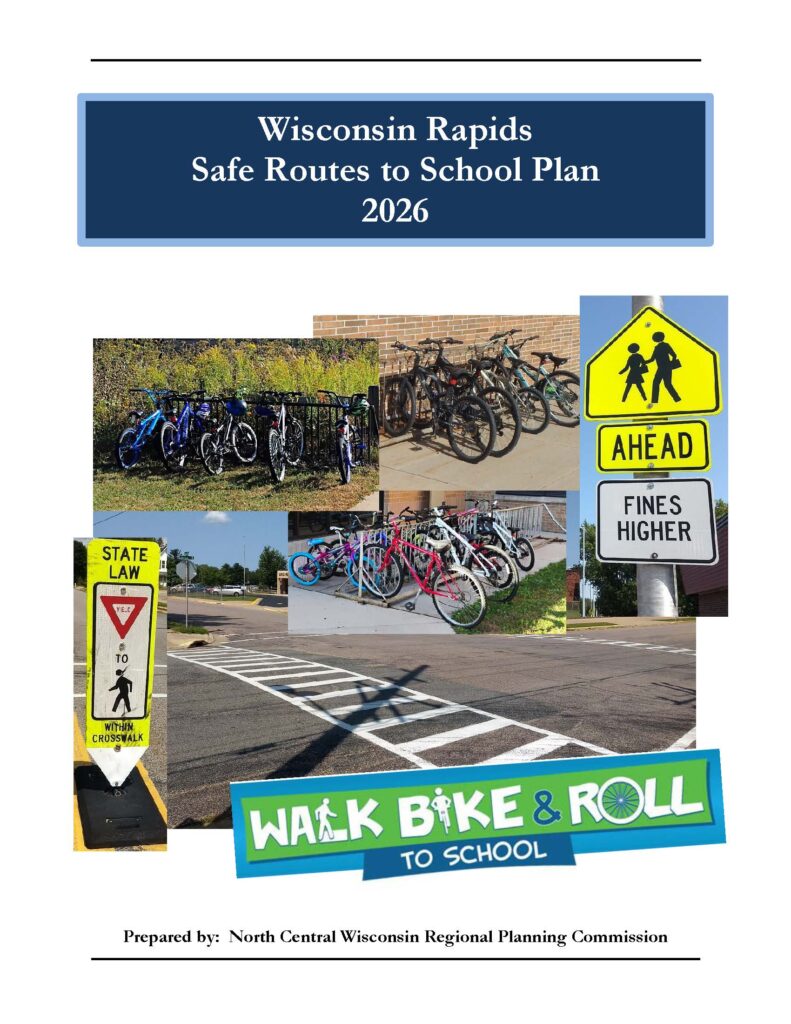
Safe Routes to School (SRTS) programs are an opportunity to make walking and bicycling to school safer for children in grades K-8, and to increase the number of children who choose to walk and bicycle. On a broader level, SRTS programs can enhance children’s health and well-being, ease traffic congestion near the school, and improve community members’ overall quality of life.
Planning Process In 2022, the North Central Wisconsin Regional Planning Commission and the Wisconsin Rapids School District won a WisDOT SRTS planning grant to create a SRTS Plan for several schools in the District. In the fall of 2023, the City and District began SRTS Planning with the assistance of the North Central Wisconsin Regional Planning Commission (NCWRPC). The NCWRPC guided the Wisconsin Rapids SRTS Task Force through the planning process.
The following schools are part of Wisconsin Rapids SRTS Planning: Wisconsin Rapids Area Middle School Grant Elementary Grove Elementary Howe Elementary Mead Elementary THINK Academy Washington Elementary Woodside Elementary
Wisconsin Rapids SRTS Task Force Ronald Rasmussen, Superintendent, WRPS Kelly Schaeffer, Wisconsin Rapids Area Middle School Principal, WRPS Tina Wallner, Grove Elementary Principal, WRPS Steve Thayer, Howe Elementary Principal, WRPS Kim Akey, Mead Elementary Principal, WRPS Rod Watson, Washington Elementary Principal, WRPS Bill Oswald, Woodside Elementary Principal, WRPS Edwin Allison, Director of Buildings and Grounds, WRPS Aaron Nelson, Business Services, WRPS Officer Dan Pelot, Student Resource Officer, WRPS Joe Eichsteadt, PE, City Engineer, City of Wisconsin Rapids Kyle Kearns, Community Development Director, City of Wisconsin Rapids Kristie Egge, MPH, Supervisor of Strategic Initiatives, Wood County Health Department Hannah Wendels Scott, FoodWIse Nutrition Educator, Wood County, UW-Madison Extension
THINK Academy Kevin Whipple, Village of Rudolph President Christine Slattery, THINK Academy Principal, WRPS Roland Hawk, Wood County Highway Commissioner
Grant Elementary Sharon Schwab, Town of Grant Chairperson Nikki Calteux, Grant Elementary Principal, WRPS Nathan Check, Portage County Highway Commissioner
Staff Fred Heider, AICP, Planner, North Central Wisconsin Regional Planning Commission